-
Description
-
Benefits
-
More info
Scalable Cell Factory for cGMP Virus Production & Cell Therapy Manufacturing
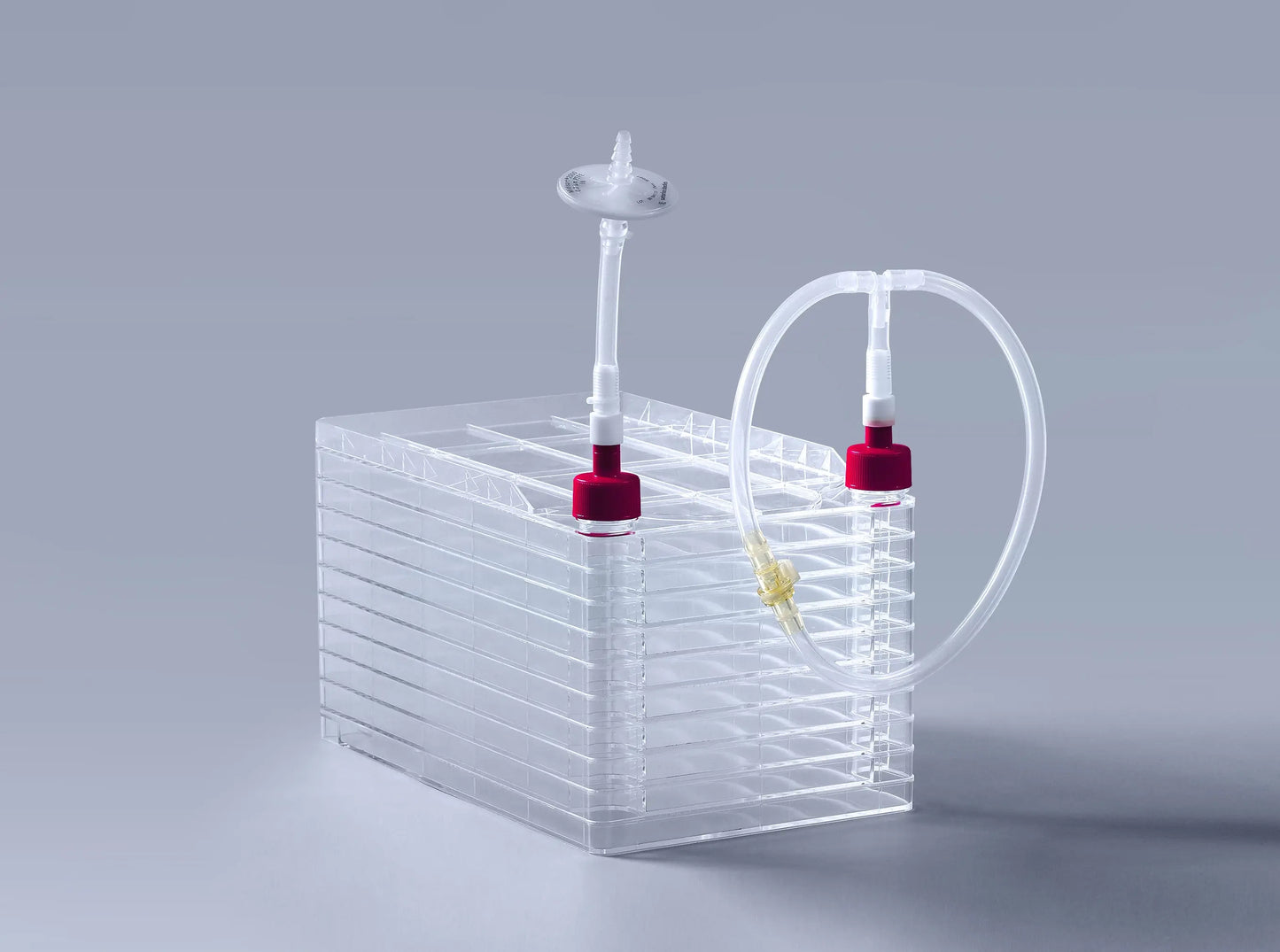
The Cell Factory TC-Treated is a premium multi-layer cell culture system engineered for large-scale adherent cell cultivation in cGMP-compliant biomanufacturing environments. Featuring tissue culture-treated surfaces and gamma irradiation sterilization, this cell factory ensures a contamination-free environment critical for sensitive applications including viral vector production, vaccine manufacturing, cell therapy development, and monoclonal antibody production.
Perfect for: AAV production, lentivirus manufacturing, adenovirus production, vaccine development, CAR-T cell therapy, stem cell expansion, and industrial-scale biopharmaceutical production.
✓ Key Regulatory Compliance
- cGMP Manufactured - Compliant with FDA and EMA guidelines
- Gamma Irradiated - 25-45 kGy sterility assurance level (SAL 10⁻⁶)
- USP Class VI Certified - Biocompatibility tested
- ISO 13485 Certified - Quality management system
- BSE/TSE Free - Raw materials traceable and certified
- Full Documentation - Certificate of Analysis, Certificate of Irradiation, Regulatory Support Files
🔬 Why Cell Factory Systems Revolutionize Large-Scale Cell Culture
Maximize Cell Yield Without Increasing Incubator Footprint
Cell Factory systems provide up to 40 layers in a single unit, delivering massive surface area (6,350 to 25,400 cm² depending on configuration) while maintaining the same footprint as a standard T175 flask. This revolutionary space efficiency means you can produce 40x more cells in the same incubator space, dramatically reducing infrastructure costs and increasing throughput.
Industry-Standard Design for Seamless Process Scale-Up
Designed to facilitate smooth transitions from bench-scale R&D to commercial-scale cGMP production, Cell Factory systems maintain consistent cell growth parameters across all layers. The standardized design ensures reproducible results when scaling from laboratory development to clinical-grade manufacturing, critical for regulatory approval and commercial success.
TC-Treated Surface: Optimized for Adherent Cell Attachment
Our proprietary tissue culture surface treatment creates a hydrophilic, negatively-charged surface that promotes optimal cell adhesion and proliferation for a wide range of adherent cell lines including:
- HEK293 & 293T cells - Viral vector production (AAV, lentivirus, adenovirus)
- Vero cells - Vaccine manufacturing (influenza, rabies, polio)
- CHO cells - Recombinant protein and monoclonal antibody production
- MDCK cells - Influenza virus production
- BHK-21 cells - Veterinary vaccine production
- Primary cells & MSCs - Cell therapy and regenerative medicine
Gamma Irradiation: Gold Standard for Terminal Sterilization
Unlike autoclave or ethylene oxide (EtO) sterilization which can damage plastic materials or leave toxic residues, gamma irradiation provides validated sterility without compromising material integrity. Each batch undergoes controlled 25-45 kGy irradiation achieving a Sterility Assurance Level (SAL) of 10⁻⁶, meeting the highest international standards for pharmaceutical manufacturing.
Why Gamma Irradiation Matters for cGMP:
- No toxic residues (unlike EtO sterilization)
- No heat damage to plastic materials (unlike autoclaving)
- Penetrates through sealed packaging for true sterility
- Validated process with documented batch-specific irradiation certificates
- Preferred method by FDA and EMA for single-use bioprocess equipment
📊 Technical Specifications
| Material | Medical-grade polystyrene (PS) - USP Class VI certified |
| Surface Treatment | TC-treated (Tissue Culture) for enhanced cell adhesion |
| Sterilization Method | Gamma irradiation (25-45 kGy, SAL 10⁻⁶) |
| Available Configurations | 1-layer (635 cm²), 2-layer (1,270 cm²), 5-layer (3,175 cm²), 10-layer (6,350 cm²), 40-layer (25,400 cm²) |
| Surface Area per Layer | 635 cm² (equivalent to 3.6× T175 flasks) |
| Cap Options | Vented cap (0.2 μm hydrophobic membrane), Sealed cap, Luer lock connection ports |
| Working Volume Range | 1-layer: 100-150 mL | 10-layer: 1,000-1,500 mL | 40-layer: 4,000-6,000 mL |
| Quality Certifications | DNase/RNase free, Pyrogen-free (<0.25 EU/mL), Non-cytotoxic, BSE/TSE free |
| Packaging | Individually wrapped, double-bagged for cleanroom compatibility |
| Shelf Life | 5 years from manufacturing date (when stored properly) |
| Storage Conditions | Room temperature (15-30°C), dry environment, away from direct sunlight |
🎯 Applications in Biomanufacturing
💉 Viral Vector Production for Gene Therapy
Cell Factory systems are the preferred choice for large-scale viral vector manufacturing in cell and gene therapy applications. The high surface area enables production of clinical and commercial-grade quantities of:
- Adeno-Associated Virus (AAV) - All serotypes for gene therapy applications
- Lentiviral Vectors (LV) - CAR-T cell therapy, ex vivo gene editing
- Adenoviral Vectors - Vaccine platforms, oncolytic viruses
- Retroviral Vectors - Gene transfer applications
Production capacity example: A 40-layer Cell Factory can produce sufficient AAV for multiple patient doses in a single production run, significantly reducing manufacturing costs per dose.
💊 Vaccine Manufacturing
Used globally by vaccine manufacturers for production of both human and veterinary vaccines:
- Influenza vaccines - High-yield virus production in MDCK or Vero cells
- Rabies vaccines - Vero cell-based production
- Polio vaccines - IPV production in Vero cells
- Veterinary vaccines - Multiple viral antigens in BHK or Vero cells
🧬 Cell Therapy & Regenerative Medicine
Essential for expanding therapeutic cells to clinically relevant numbers:
- CAR-T cell therapy - T-cell expansion for cancer immunotherapy
- Mesenchymal stem cells (MSCs) - Allogeneic cell therapy products
- Induced pluripotent stem cells (iPSCs) - Large-scale differentiation protocols
- NK cells - Natural killer cell therapy manufacturing
🔬 Monoclonal Antibody & Protein Production
Ideal for early-stage development and small-scale cGMP production:
- CHO cell culture - Recombinant protein expression
- Hybridoma cells - Monoclonal antibody production
- HEK293 cells - Transient protein expression
🧪 Process Development & Clinical Trial Material
Bridge the gap between research and full-scale manufacturing:
- Process optimization and parameter screening
- Phase I/II clinical trial material production
- Tech transfer validation from suspension to adherent platforms
- Backup production for supply chain resilience
⚡ Advantages Over Alternative Culture Systems
| System | Cell Factory | T-Flasks | Bioreactors |
|---|---|---|---|
| Setup Complexity | ✅ Simple, no training needed | ✅ Simple | ❌ Complex, requires expertise |
| Capital Investment | ✅ Low ($-$$) | ✅ Very low ($) | ❌ High ($$$$) |
| Scale-Up Capability | ✅ Excellent (1-40 layers) | ❌ Limited (labor intensive) | ✅ Excellent |
| Space Efficiency | ✅ 40× more area per footprint | ❌ Poor (1 incubator/shelf) | ⚠️ Moderate |
| Contamination Risk | ✅ Low (closed system) | ⚠️ Moderate (open handling) | ✅ Low (closed system) |
| Cell Type Compatibility | ✅ Adherent cells only | ✅ Adherent only | ✅ Both adherent/suspension |
| Labor Requirements | ✅ Low | ❌ High (many units) | ⚠️ Moderate |
| Process Consistency | ✅ High (validated) | ⚠️ Variable (operator-dependent) | ✅ Very high (automated) |
| Best Use Case | Clinical to small commercial | R&D only | Large commercial scale |
📋 Quality Documentation & Regulatory Support
Complete cGMP Documentation Package Included
Every batch comes with comprehensive documentation to support your regulatory filings:
- Certificate of Analysis (CoA) - Batch-specific quality test results
- Certificate of Irradiation (CoI) - Gamma irradiation dosimetry report with min/max/average dose
- Material Safety Data Sheet (MSDS/SDS) - Safety information and handling guidelines
- Regulatory Support Files (RSF/DMF) - Comprehensive manufacturing documentation for regulatory submissions
- Extractables & Leachables Study - Available upon request for IND/BLA filings
- Biocompatibility Testing - USP Class VI, ISO 10993 compliance data
- Sterility Testing Reports - USP <71> validation data
- Endotoxin Testing - LAL test results (<0.25 EU/mL)
- BSE/TSE Certificates - Raw material traceability documents
Regulatory Compliance Standards Met
- ✓ FDA 21 CFR Part 210/211 (cGMP for Finished Pharmaceuticals)
- ✓ FDA 21 CFR Part 820 (Quality System Regulation for Medical Devices)
- ✓ EMA Annex 1 (Manufacture of Sterile Medicinal Products)
- ✓ ICH Q7 (Good Manufacturing Practice Guide for Active Pharmaceutical Ingredients)
- ✓ ISO 13485 (Medical Devices Quality Management)
- ✓ USP <87> (Biological Reactivity Tests, In Vitro)
- ✓ USP <71> (Sterility Tests)
- ✓ Ph. Eur. 3.2.2 (Plastic Containers for Aqueous Solutions)
🔧 Usage Guidelines & Best Practices
Pre-Culture Preparation
- Visual Inspection: Examine packaging integrity and product for any damage
- Equilibration: Allow Cell Factory to reach room temperature (20-30 min)
- Priming (Optional): Some cell types benefit from pre-coating with ECM proteins (collagen, fibronectin, poly-L-lysine)
- Media Pre-warming: Warm culture media to 37°C before use
Cell Seeding
- Calculate Seeding Density: Typically 5,000-10,000 cells/cm² depending on cell type
- Volume Distribution: Use recommended media volumes (see specifications table)
- Uniform Distribution: Rock Cell Factory gently in all directions to ensure even cell distribution across all layers
- Horizontal Incubation: Place flat in CO₂ incubator for first 2-4 hours to allow cell attachment
Culture Maintenance
- Media Exchange: Replace 50-100% of media every 2-3 days depending on cell density and metabolic activity
- Monitoring: Regular pH monitoring (phenol red indicator) and microscopic examination of cell morphology
- Temperature Control: Maintain at 37°C in humidified atmosphere with 5% CO₂
Cell Harvesting
- Remove Media: Aspirate spent media from all layers
- PBS Wash: Rinse with sterile PBS to remove serum proteins
- Trypsinization: Add appropriate volume of trypsin-EDTA (5-10 mL per layer)
- Incubation: 5-7 minutes at 37°C until cells detach (monitor microscopically)
- Neutralization: Add serum-containing media or trypsin inhibitor
- Cell Recovery: Tilt Cell Factory to collect cell suspension from uppermost port
- Cell Count: Use automated cell counter or hemocytometer for viability and density
📦 Available Configurations & Ordering Information
| Layers | Total Surface Area | Typical Cell Yield* | Best Application |
|---|---|---|---|
| 1-Layer | 635 cm² | ~60-100 million | Process development, small-scale production |
| 2-Layer | 1,270 cm² | ~120-200 million | Research-grade material, optimization |
| 5-Layer | 3,175 cm² | ~300-500 million | Pre-clinical studies, pilot batches |
| 10-Layer | 6,350 cm² | ~600 million-1 billion | Clinical trial material (Phase I/II) |
| 40-Layer | 25,400 cm² | ~2.4-4 billion | Commercial manufacturing, large-scale production |
*Cell yield estimates based on HEK293 cells at 80-90% confluence. Actual yields vary by cell type, culture conditions, and application.
Cap Configuration Options
- Vented Cap: 0.2 μm hydrophobic membrane for sterile gas exchange (standard for most applications)
- Sealed Cap: Completely closed system for short-term transport or storage
- Luer Lock Ports: Closed-system fluid transfer compatible with tube welding and aseptic connectors
❓ Frequently Asked Questions
What is the difference between TC-treated and non-treated surfaces?
TC (tissue culture) treatment creates a hydrophilic, negatively-charged surface through corona discharge or plasma treatment. This enhances protein adsorption and cell adhesion for adherent cell lines. Non-treated surfaces are hydrophobic and suitable only for suspension cell culture. For adherent cells (HEK293, Vero, CHO, etc.), always use TC-treated Cell Factories.
Why is gamma irradiation preferred over autoclave sterilization?
Gamma irradiation is the gold standard for sterilizing plastic cell culture vessels because it: (1) doesn't require heat that would melt/warp plastics, (2) leaves no toxic chemical residues like EtO, (3) provides validated sterility (SAL 10⁻⁶), and (4) is performed on sealed, packaged products ensuring maintained sterility until use. This is critical for cGMP compliance.
Can I use Cell Factories for suspension cell culture?
No, Cell Factories are designed specifically for adherent cell culture. The multi-layer stacked design requires cells to attach to the TC-treated bottom surface of each layer. For suspension cells (e.g., CHO-S, HEK293 suspension), use spinner flasks, shake flasks, or bioreactors instead.
How do I know which layer configuration to choose?
Start with 1-2 layer Cell Factories for process development and optimization. Once your process is established, scale linearly: 5-layer for pre-clinical work, 10-layer for Phase I/II clinical material, and 40-layer for commercial-scale manufacturing. Total surface area scales proportionally (1-layer = 635 cm², 40-layer = 25,400 cm²).
What documentation do you provide for regulatory submissions?
Every batch includes: Certificate of Analysis, Certificate of Irradiation, MSDS, and lot-specific quality test results. We also provide Regulatory Support Files (RSF/DMF) upon request containing comprehensive manufacturing information, extractables/leachables data, biocompatibility testing, and raw material traceability for IND/BLA/MAA submissions.
Are your Cell Factories compatible with closed-system processing?
Yes! Cell Factories with Luer lock connection ports enable fully closed-system operations when combined with tube welders and aseptic connectors. This minimizes contamination risk and is preferred for cGMP manufacturing. Standard vented cap versions allow sterile gas exchange while maintaining a closed environment.
What is the shelf life and storage requirement?
Cell Factories have a 5-year shelf life from the manufacturing date when stored at room temperature (15-30°C) in a dry environment away from direct sunlight. The gamma irradiation sterilization ensures maintained sterility throughout the shelf life when packaging remains intact.
Packaging:
Min package: 1 pcs/pack
Sales Package: 8 packs/case
Pcs/Case: (8 pcs total per case)
Carton size: 61 X 41 X 57
Gross weight: 6.5 kg
Pair text with an image to focus on your chosen product, collection, or blog post. Add details on availability, style, or even provide a review.